
META Market Opportunity 14.10.2026.
- Meta Platforms (ticker: META) – OCTOBER 21, AFTER MARKET: Q3 EARNINGS REPORT. Meta is expected to report its Q3 2026 results on Wednesday, October 21, 2026, with the earnings call scheduled after market close.
- The company
Meta Platforms is the world’s largest social media platform. The company’s portfolio has evolved from the Facebook app to multiple apps, including photo and video sharing app Instagram and WhatsApp messaging app, largely through acquisitions. Along with in-house developed Messenger and newer services such as Threads, these products form Meta’s Family of Apps, which reached about 3.60 billion daily active people on average in June 2026. -
The numbers
Q2 2026 revenue came in at $60.80 billion, up 28% year over year. Diluted EPS of $6.18 fell 13% and missed estimates, but two discrete charges explain most of the gap: a $2.40 billion legal charge and $1.18 billion in severance tied to a May headcount reduction. Strip those out and the underlying business is in good shape. Excluding the legal charges and severance, operating income would have increased 9% year over year.
Daily active users across all apps reached 3.6 billion, with Instagram surpassing 2 billion daily actives and Threads exceeding 500 million monthly actives. Ad impressions across the Family of Apps grew 14%, and the average price per ad increased 12%. Both numbers moving up together is the combination advertisers and investors want to see. -
AI is the real story
The advertising numbers are good. The reason they’re good is what matters. The primary catalyst for growth is “Andromeda,” a sophisticated AI architecture Meta rolled out in late 2025. It evaluates billions of real-time behavioral signals to match content with users, effectively removing human error from ad targeting. Meta’s AI systems are making ads more efficient, meaning revenue growth can accelerate without a proportional increase in ad load.
On the open-source side, Meta is positioning Llama as open infrastructure, pulling developers and enterprises into its ecosystem while pushing deployment costs outward. If Llama becomes a default layer for AI development, Meta benefits indirectly through better products, faster innovation, and ecosystem gravity. -
Muse Wonder – AI race escalates
Two days ago, on Monday October 12, Meta took its AI push a step further, launching Muse Wonder and Muse Wonder Full, described by the company as its most capable AI models to date. The announcement is a direct signal that Meta is no longer content to sit behind OpenAI and Anthropic in the foundation model race. It wants a seat at the top table.
The timing is deliberate. With Q3 earnings less than two weeks away, launching flagship models now gives Zuckerberg a concrete product story to tell on the October 21 call and not just infrastructure spend and capex guidance, but actual models that users and developers can point to. That's a meaningful shift from earlier in the year, when the AI narrative was largely about what Meta was building rather than what it had shipped. -
The earnings event - October 21
The company guided Q3 revenue of $61-$64 billion and raised its full-year 2026 total expense outlook to $165–$169 billion, reflecting the Q2 legal charge, while reiterating it expects 2026 operating income to be above 2025. The Street’s Q3 consensus sits at $63.28 billion in revenue and $6.50 EPS. The stock has had a Post-Earnings Announcement Drift of +17.3% since the last earnings release on July 29. That means the market rewarded the Q2 report considerably after the initial reaction, a detail worth keeping in mind heading into October 21. -
Capital Expenditure
This is the part of the Meta story that divides opinion. Capital expenditures reached $31.08 billion in Q2 2026 alone, and full-year CapEx guidance was narrowed to $130-$145 billion. That is an enormous number, larger than the entire annual revenue of most S&P 500 companies. The bull case is that this infrastructure spend translates into AI capability that competitors simply cannot match at scale. The bear case is that the returns on that spending remain unproven and the costs are compressing margins in the near term. Zuckerberg pledged up to $135 billion in capex for 2026, primarily for AI infrastructure, arguing that Meta’s scaled-down Llama models have already successfully boosted user engagement and advertising profitability. -
Technical analysis
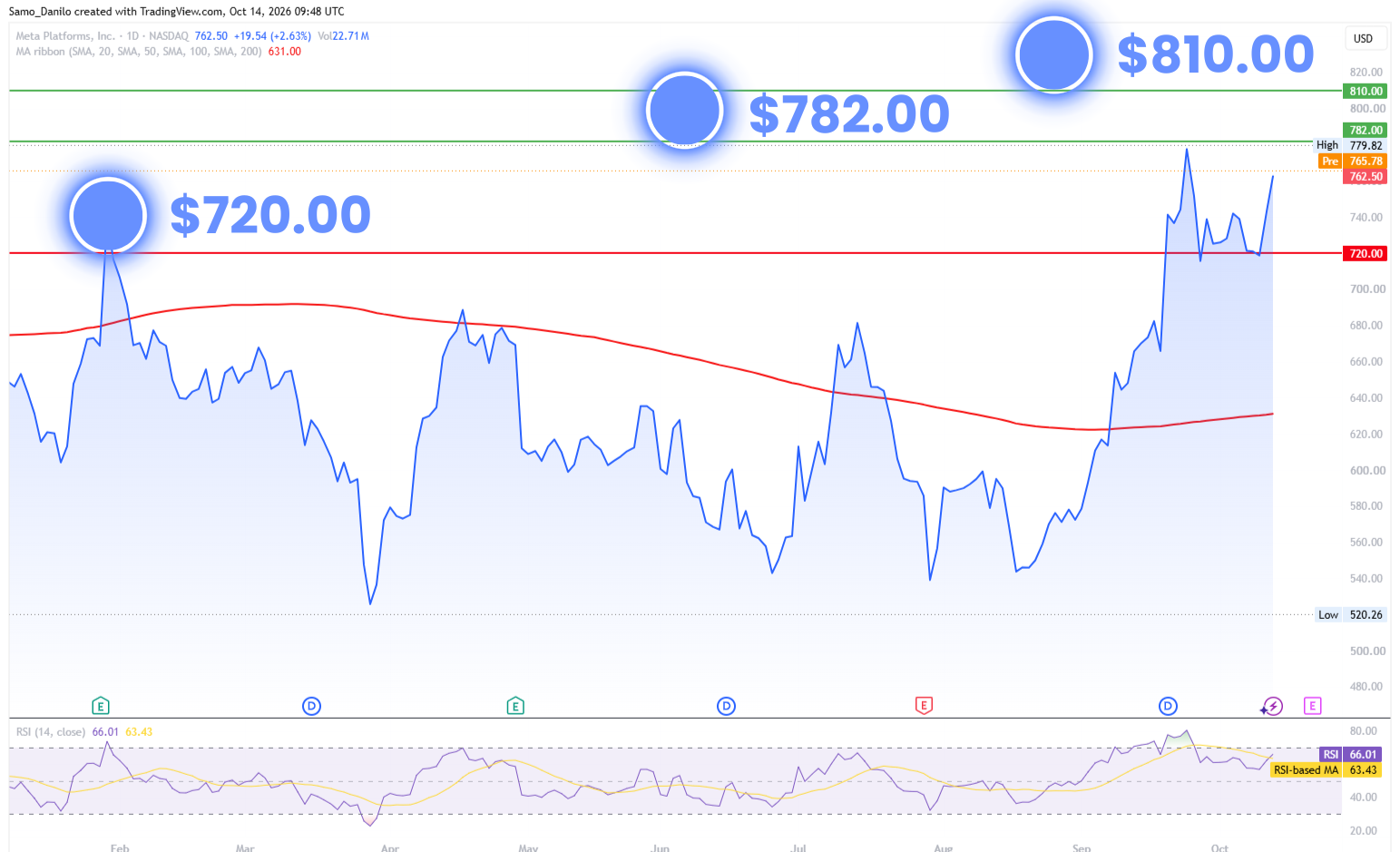
Meta spent most of 2026 in a grinding correction, falling from February highs near $750 all the way down to a year low of $520.26 in March, a 30% drawdown that lasted the better part of six months. The 200 SMA was declining throughout, confirming the trend was genuinely broken rather than just a temporary pullback.
What happened next is the story. From August, the stock staged a sharp and sustained recovery, rallying around 46% in under two months to reach $762.50 today, just below the year’s high of $779.82. Price has convincingly recrossed the 200 SMA, which is now beginning to turn upward - the most important structural signal on the chart. RSI at 66.01 shows strong momentum without yet being overbought, and is holding above its own moving average of 63.43, a healthy setup heading into earnings.
In short, a painful correction, a convincing recovery, and the technical and fundamental calendars now aligned at the same time. -
The risk
Three things to watch. First, cost growth. Total costs and expenses rose 55% year over year in Q2 to $42.03 billion, more than double the pace of revenue growth. That gap needs to narrow. Second, regulatory exposure. Meta continues to monitor active legal and regulatory matters, including youth-related litigation, that could materially affect its business and financial results. The $2.4 billion legal charge in Q2 was a reminder that this is not an abstract risk. Third, Reality Labs continues to lose money at scale, the segment generated $431 million in revenue against an operating loss of $4.62 billion. -
A notable footnote - Trump’s $25 million META purchase
There is one development that sits outside the usual analytical framework but is worth noting. According to CNBC, President Trump disclosed 517 securities transactions in August, totaling between $74 million and $273 million. His largest single equity purchase was between $5 million and $25 million in Meta shares, making it the standout position in a disclosure that also included AT&T, Netflix and Chevron. -
Bottom line
Meta heads into its Q3 earnings report on October 21 with the core advertising business in solid shape, AI-driven improvements to targeting and engagement showing up in the actual numbers, and 3.6 billion daily users giving it a distribution advantage that no competitor can replicate from scratch. The cost structure is the thing to watch - both in the upcoming report and in how management discusses the CapEx trajectory going forward. For a long-term CFD position, the business is fundamentally strong. The next two weeks will tell us whether the market is ready to price that in.
Meta Platforms (META) calculation example:
- Expected Price Direction: Up
- Position Type: Long
- Investment Budget Example: $1000
- Investment Size: 0.1 lot = 10 share (1 lot=100 shares)
| Close Price (Scenario 2) | $810.00 | + $475.00 |
| Close Price (Scenario 1) | $782.00 | + $200.00 |
| Open Price | $762.50 | |
| Close Price (Scenario 3) | $720.00 | - $425.00 |
This report is for informational purposes only and does not constitute financial advice. CFD trading involves risk and may not be suitable for all investors.